Jobs-to-be-Done framework for Product Marketing
The framework has shifted the landscape for many businesses thinking about product innovation and their go-to-market strategy. Credits to Bob Moesta (Re-wired Group) and Clayton Christensen (HBS Professor).

We are here to "do a job"
The framework explains why some people "hire" (buy) products and why certain tradeoffs are made in our customers' mind.
It is worth mentioning that the phrase "job-to-be-done" (JTBD) has been carefully worded to reflect that this is about perceived progress or outcomes in our customers mind.
The reason why it isn't about "problem-based-selling" is because there are usually both social and functional dimensions and "problems" doesn't really encapsulate it.
Jobs are about a "journey"
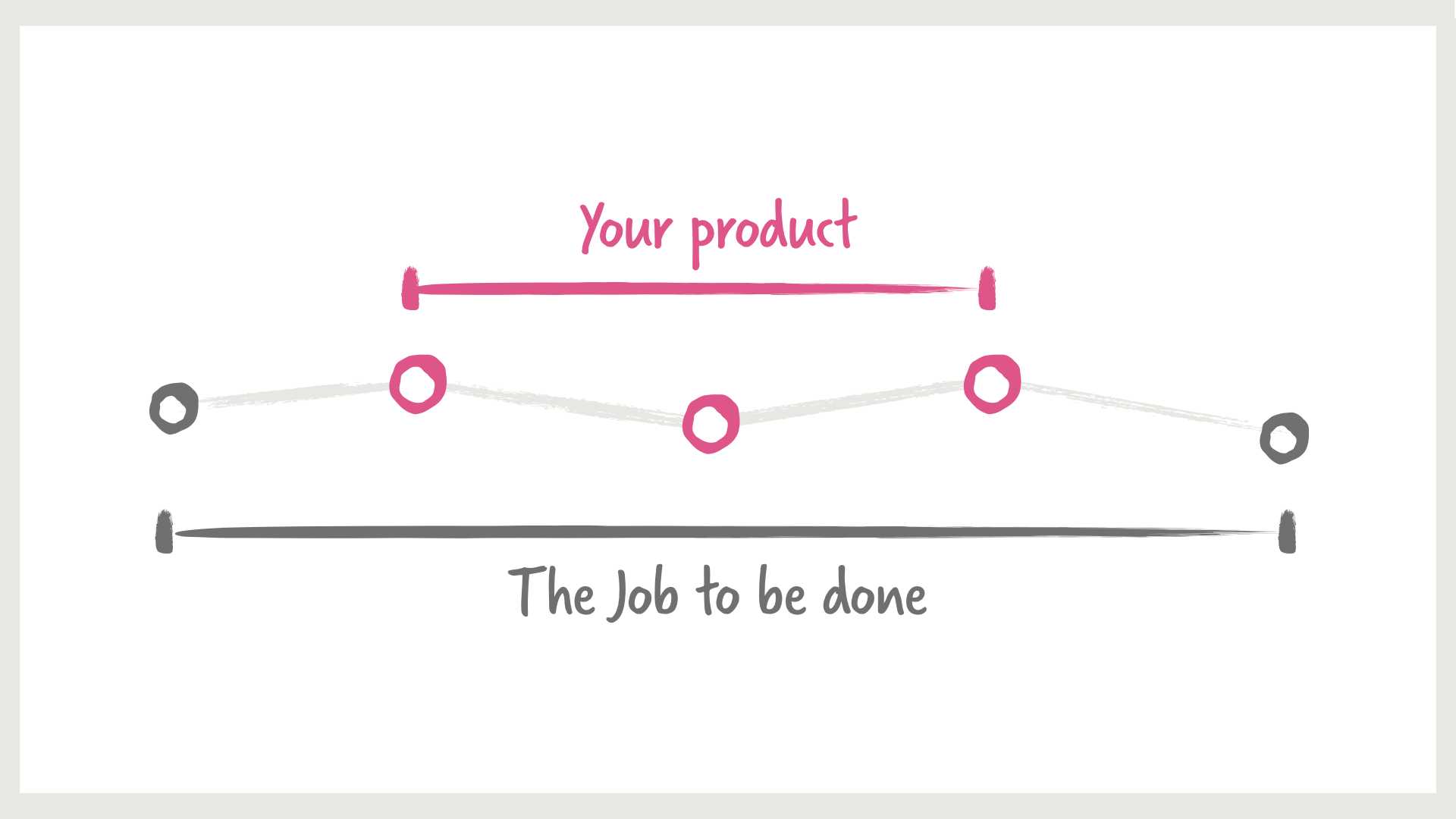
Your product or service doesn't have to cover the whole journey. It has to serve the points along that "journey".
E.g. Microsoft Word: One of the most commonly used tools today
- After I'm done writing, I have to submit X to my editor, print & update my project mates.
-
The next three steps are done on
- Email Printer
- Laser Printer
- Project management app
- Microsoft did not have to cater to every step
Cater to the first step that you can add "progress" from the status quo.
Why the buzz?
Before JTBD, we'd all thought that the best way to target our audience was through demographics:
Middle aged women. 2 kids. Married. Asian
What we've all learnt is that NONE of these characteristics actually cause me to buy something. They do however, correlate (will come back to this, don't throw this away).
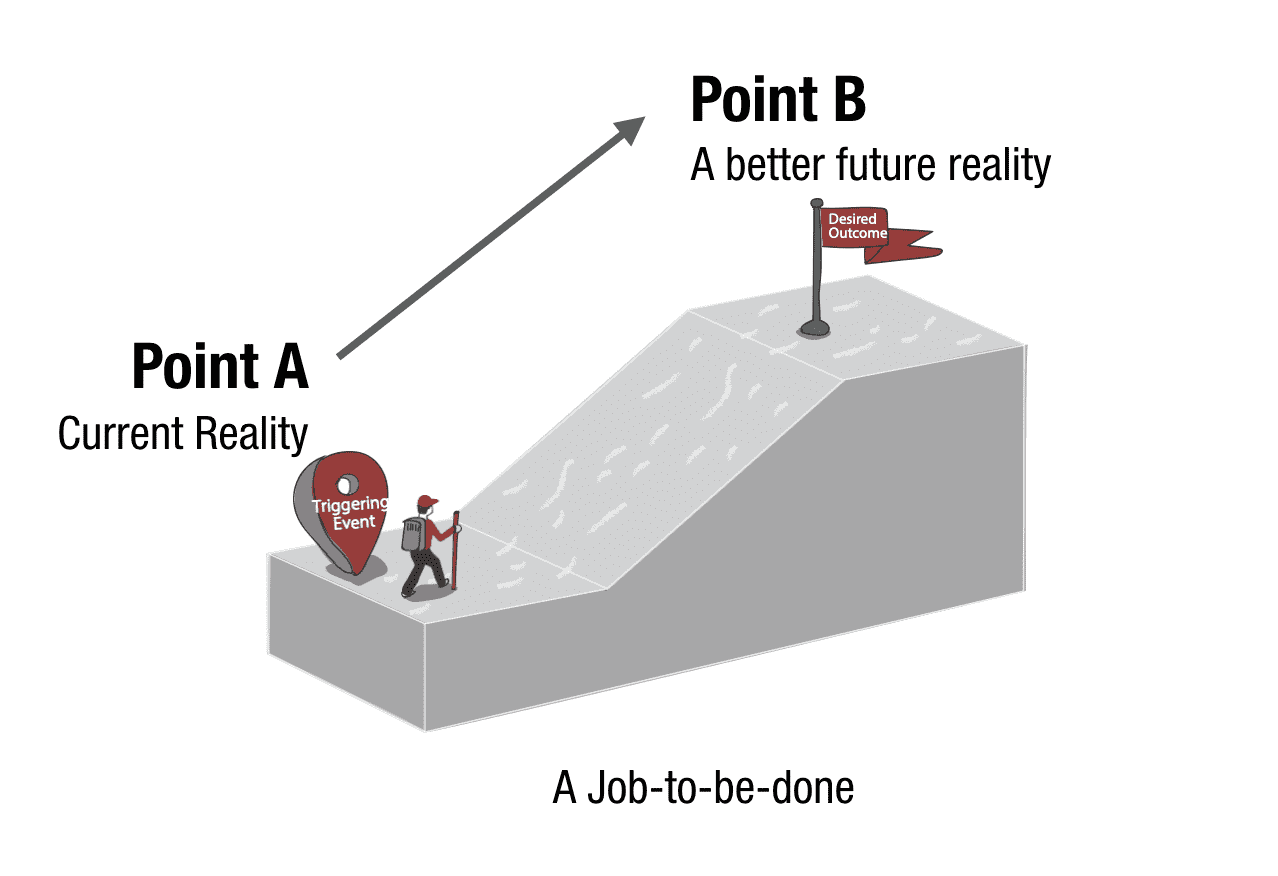
JTBD: Context, Annoyance, Trigger & Progress
- I have always been doing X (context)
- X seems repetitive, annoying, painful (insert annoyance)
- One day Y happens (trigger)
- Search for Progress
If you are a marketer, you might be thinking "OH! I have to insert myself at Y".
That's not entirely correct.
Advertisement & marketing campaigns are rarely true triggers.
Think about how many promotions are going on in the world right now. How many products are you buying?
There has to be an Annoyance and a Trigger
Competitive Set: Friendship & Beds
Competition only makes sense in the journey towards progress (Job).
When your product surfaces, it could be ONE of the many possible alternatives.
- I have always been showing up to work late
- My manager occasionally warns me about showing up to work late
- One day, my manager said she would fire me if it happened again
-
In search for progress: I could...
- Get a louder alarm clock
- Shift from buses to personal car
- A more comfortable bed to get better sleep
- Non-products: A friend to call me, Another job close to home
Competition doesn't make sense without context.
Competition doesn't begin until the trigger.
Fired from the Job
As illustrated from the previous section, whenever there is a new "hire" there will also be something "fired".
- Soft to loud alarm
- Bus to car
- Bad sleep to good sleep
- Social capital for something else to calling me to wake me up
- Old job to job closer to home
This next section is super important
To understand how to "design for progress", you have to first understand it.
Product Design, Copywriting & Sales
There will always be a temptation to tout the 1,000+ features that are vastly superior.
But most of them don't really matter.
Using the example from the previous section, would a solar-powered, environmentally-friendly, digital clock matter?
No. Unless it was louder than what I already have.
Understanding the "vector-of-progress" is what aids in design and sales.
-------
PS: Need slides? Check them out here.
--------
Why I write
Product marketing has become an increasingly important role in many businesses.
But what does that mean for you?
I write about marketing strategy and tactics from the lens of product marketing so that you can keep tabs on the product marketing landscape.
Whenever I learn something new, I share it here on this blog
As an added bonus, we use it to reflect on our own product development and marketing efforts.
Subscribe to learn along with me!
Tags
Learn more about strategies & tactics from the
product marketing perspective
Delivered once a week to your inbox